
Online searches for a February 2026 $2,000 federal deposit have surged as households look for clarity about possible government payments. Many Americans want to know: Is this payment real? Who qualifies? When would it arrive?
As of now, there is no officially confirmed nationwide $2,000 deposit being automatically sent to all Americans. Any federal payment must first be approved through legislation and formally announced by the responsible agency before funds are distributed.

Here’s what you need to understand about how federal payments work, potential eligibility factors, and what affects timing.
How Federal Payment Programs Normally Work
When a federal payment program is authorized, it follows a structured process. Agencies such as the IRS or Social Security Administration use existing systems to issue payments.
Key Steps in the Process
- Legislative approval
- Eligibility screening
- Identity verification
- Banking validation
- Batch processing and release
Payments are not issued instantly. Each record must pass verification checks before funds are sent.
Basic Eligibility Factors (If a Program Is Approved)
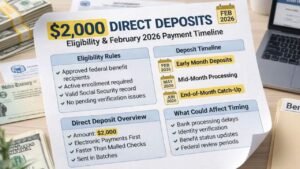
While no universal $2,000 payment is currently confirmed, relief-style programs typically consider:
- Income level
- Filing status
- Valid Social Security number
- Recent tax return records
- Enrollment in federal benefit programs
Groups Often Prioritized in Relief Programs
- Lower-income households
- Seniors receiving Social Security
- SSDI or SSI recipients
- Veterans receiving federal benefits
Eligibility always depends on official criteria. Not everyone automatically qualifies.
Why Verification Is Required
Verification protects both taxpayers and the federal system. Before funds are released, agencies confirm:
- Identity details
- Income records
- Bank account information
- Duplicate payment checks

If information doesn’t match official databases, payments may be delayed for manual review.
Manual reviews take longer because records are examined individually to prevent fraud or errors.
Payment Timing: Why Not Everyone Gets Paid the Same Day
Federal payments are usually released in waves, not all at once.
How Batch Processing Works
- Approved recipients are grouped into batches
- Payments are released over several days or weeks
- Earlier approvals are paid first
Even eligible individuals may receive funds on different dates depending on when their records clear verification.
Direct Deposit vs. Paper Check
The delivery method significantly affects timing.
Direct Deposit
- Fastest option
- Funds move electronically
- Typically arrives within days of approval
Paper Check
- Slower processing
- Requires printing and mailing
- Delivery depends on postal timelines
If speed matters, electronic deposit is generally the better option.
Common Reasons for Payment Delays
Even when someone qualifies, delays can occur due to:
- Incorrect bank account details
- Closed or inactive accounts
- Name mismatches
- Fraud prevention reviews
- High processing volume
Incorrect banking information is one of the most frequent causes of rejected deposits.
How to Track Federal Payment Status
If an official payment program is active, agencies typically provide tracking tools.
Where to Check
- IRS online account (for tax-related payments)
- “Where’s My Refund?” tool (during tax season)
- Social Security online portal (for benefit payments)
Only use official government websites to avoid scams.
Smart Financial Planning While Waiting
If you are expecting a potential federal payment:
- Avoid making spending decisions based on rumors
- Treat estimated timelines as general guidance
- Keep your tax filings current
- Update bank and mailing information if necessary
Staying proactive reduces unnecessary delays.
FAQs About the February 2026 $2,000 Deposit
1. Is there a confirmed $2,000 federal payment in February 2026?
No. There is no officially approved universal $2,000 deposit at this time.
2. Who would qualify if a payment were approved?
Eligibility would likely depend on income, filing status, and enrollment in federal programs.
3. Why are some people seeing $2,000 deposits?
Many deposits around this amount are tax refunds or regular benefit payments.
4. How long do federal payments usually take?
Processing varies, but direct deposits typically arrive faster than mailed checks.
5. How can I avoid payment scams?
Only trust official government websites and never share personal details through unsolicited messages.
Final Thoughts
The discussion around a February 2026 $2,000 federal deposit highlights how quickly payment rumors can spread. While financial relief programs are possible in certain circumstances, they require formal approval and structured processing before funds are distributed.
Understanding how federal payment systems work helps you set realistic expectations and avoid misinformation. If a new program is approved, official government sources will provide clear instructions and timelines.
Until then, rely on verified updates, keep your records accurate, and make financial decisions based on confirmed information — not speculation.