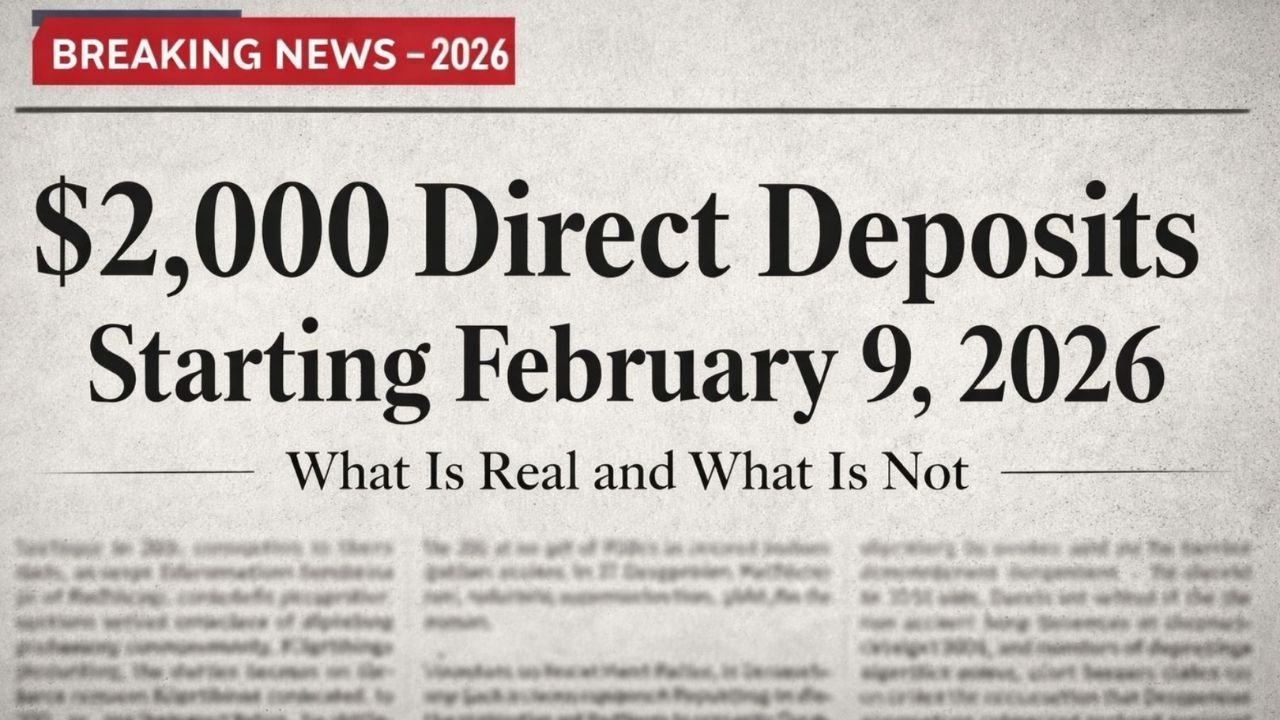
In early February 2026, headlines and social media posts began circulating with a bold claim: $2,000 direct deposits would begin landing in bank accounts starting February 9. Screenshots of account balances, short-form videos, and forwarded messages fueled the narrative, creating a wave of excitement among households already navigating higher living costs.
But when examined closely, the story behind these claims looks very different. There is no officially approved nationwide $2,000 federal payment program scheduled to begin in February 2026. The deposits people are seeing stem from routine financial processes — not a new stimulus initiative.

Understanding the distinction is essential for financial clarity and security.
No New Federal $2,000 Program Has Been Authorized
Government relief programs do not launch quietly. When federal payments are approved, they are introduced through legislation, followed by formal announcements, press briefings, and clear guidance on eligibility and distribution timelines.
As of February 2026, no new law authorizes a universal $2,000 stimulus or emergency direct deposit for the general public. There has been no confirmed policy rollout, no agency directive announcing such payments, and no structured eligibility framework supporting the claim.

The absence of official confirmation is a strong indicator that viral reports are based on misunderstanding rather than policy reality.
Why the $2,000 Figure Feels Familiar
The number itself plays a powerful psychological role.
During previous economic disruptions, stimulus payments in the range of $1,200 to $2,000 became widely discussed. That figure has since remained embedded in public memory as a symbol of government financial relief.

When individuals see deposits close to $2,000 in their bank accounts, it is easy to associate the amount with a new stimulus program. Social media platforms amplify this connection by repeating the number without context. Once a few posts gain traction, the narrative can spread rapidly, even without factual backing.
In the digital age, repetition often creates perceived legitimacy.
February Is Peak Tax Refund Season
The most significant factor driving confusion is timing.
February marks one of the busiest periods for federal income tax refunds. Many taxpayers file returns as soon as the filing season opens. Those who file early and choose direct deposit frequently receive refunds within weeks.
Refund amounts vary widely based on:
- Income levels
- Tax withheld throughout the year
- Filing status
- Number of dependents
- Eligibility for refundable credits
Credits such as earned income-related benefits and child-focused tax provisions can substantially increase refund totals. When combined with excess withholding from paychecks, many refunds naturally approach or exceed $2,000.
For early filers, deposits around February 9 are entirely consistent with normal IRS processing timelines. These are not new stimulus payments — they are standard tax refunds.
Regular Benefit Payments Continue as Scheduled
Another source of confusion involves existing federal benefit programs.
Retirement benefits, disability support, and veterans’ payments are distributed on structured monthly schedules. Payment amounts are calculated individually based on work history, earnings records, contribution levels, and eligibility status.
For some recipients, monthly benefits may be near $2,000. When those payments arrive close to tax refunds, the total funds appearing in an account may seem unusually large.
However, these are separate systems operating independently. A retirement payment and a tax refund deposited within days of each other can create the illusion of a single large federal disbursement.
In reality, it is simply overlapping timing.
Calendar Effects Can Shift Deposit Dates
Banking and government payment systems do not operate every day of the week. When a scheduled payment date falls on a weekend or federal holiday, deposits may be processed earlier or later.
This calendar shift can result in multiple payments posting within a narrow window. To someone scanning their account activity, the proximity may appear intentional or coordinated.
It is not.
Each payment follows its own administrative schedule. The appearance of a combined or accelerated payout is often just a reflection of business-day adjustments.
Individual Eligibility Determines Payment Amounts
A key flaw in viral claims about a $2,000 direct deposit is the suggestion that everyone will receive the same amount at the same time.
That is rarely how government finance programs function.
Tax refunds are individually calculated. Benefit payments are determined by personal records. Assistance programs apply specific eligibility criteria. There is no automatic equal distribution unless a formal law creates one — and no such law currently exists for February 2026.
Uniform claims across social media often ignore these structural realities.
Increased Risk of Scams During Payment Rumors
Whenever rumors of large government payments spread, fraudulent activity tends to rise.
Scammers exploit uncertainty and hope. Common tactics include:
- Messages requesting bank verification to “release” a payment
- Emails claiming eligibility confirmation is required
- Fake websites mimicking official government portals
- Requests for small processing fees
Legitimate government agencies do not request sensitive information through unsolicited texts, direct messages, or unofficial links.
Financial security depends on caution. Verifying information through official government websites or trusted financial professionals is the safest course of action.
The Financial Planning Perspective
For households managing budgets, clarity matters more than speculation.
Relying on unconfirmed payment rumors can lead to unrealistic financial expectations. Responsible planning should be based on confirmed income sources — such as verified tax refunds, approved benefits, and documented earnings.
Understanding how payment systems operate reduces uncertainty and protects long-term financial stability.
In a period where economic headlines travel quickly and digital content spreads instantly, measured verification becomes a financial skill in itself.
The Bottom Line for February 9, 2026
There is no officially approved nationwide $2,000 direct deposit program beginning February 9, 2026.
Deposits around that amount are coming from routine processes — primarily tax refunds and existing benefit payments. The timing overlap has created confusion, amplified by social media repetition.
Clear information cuts through the noise.
Before adjusting budgets or sharing payment claims, individuals should confirm details through authoritative sources. In today’s fast-moving information landscape, informed decision-making remains the most valuable asset.