
Discussion around a potential $2,000 federal direct deposit in February 2026 has gained significant attention across the United States. Many households are asking whether this payment is officially approved, who might qualify, and when funds could arrive.
Unlike the broad stimulus checks issued during national emergencies in previous years, this proposed payment is being described as targeted financial relief rather than universal stimulus. The concept centers on delivering support efficiently through existing federal systems to households still managing elevated living costs.

Here is a clear, fact-based breakdown of what is being discussed and what it could mean.
Why a $2,000 Federal Payment Is Being Considered
While inflation has moderated compared to earlier peaks, everyday expenses remain noticeably higher than they were just a few years ago. Many households continue to face pressure from:
- Housing and rental increases
- Higher grocery bills
- Rising healthcare expenses
- Insurance and transportation costs
- Elevated utility bills
Even with steady employment growth in many sectors, wage increases have not fully offset higher living costs for everyone. Policymakers have therefore discussed targeted relief options that would support lower and middle-income households without launching a broad, economy-wide stimulus program.
The goal of such a proposal is stability — helping families manage essential expenses without triggering large-scale economic overheating.
How This Payment Would Be Structured
Using Existing Federal Systems
Rather than creating a new application process, the proposed approach would rely on existing federal databases, including:
- Recent tax return filings
- Social Security records
- SSDI and SSI beneficiary data
- Veterans Affairs payment systems
This structure allows faster distribution while minimizing administrative complexity. By using already verified information, federal agencies could reduce processing delays and lower the risk of fraud or duplicate payments.
Targeted, Not Universal

Unlike pandemic-era stimulus checks that reached a wide population, this proposal would likely include:
- Income-based eligibility thresholds
- Phase-outs for higher earners
- Automatic qualification for certain federal benefit recipients
This means not every American would receive the full $2,000 — or any payment at all.
Potential Eligibility Criteria
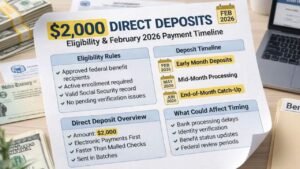
While no final program has been officially confirmed, discussions suggest eligibility could focus on the following groups:
1. Recent Federal Tax Filers
Individuals and families who filed 2025 tax returns may be evaluated based on:
- Adjusted gross income (AGI)
- Filing status
- Dependent status
Income limits would likely determine whether recipients receive the full amount, a partial payment, or no payment.
2. Social Security Recipients
This may include:
- Retirement beneficiaries
- SSDI recipients
- SSI recipients
Benefit status could automatically qualify individuals without requiring additional paperwork.
3. Veterans Receiving Federal Benefits
Eligible veterans already receiving VA compensation may also fall within qualifying categories, depending on income rules.
4. Low to Moderate-Income Workers
Workers within certain income thresholds could qualify through tax records, even if they are not receiving federal benefits.
Because existing systems would be used, most eligible individuals would not need to submit new applications.
Expected Payment Schedule for February 2026
If approved and funded, payment timing would likely prioritize speed and electronic delivery.
Direct Deposit – First Wave
Direct deposits would likely arrive first for individuals who:
- Previously received tax refunds electronically
- Have current bank information on file with the IRS or SSA
Estimated timeline: Early to mid-February 2026
Prepaid Debit Cards
For recipients without direct deposit information on file, prepaid government debit cards may be issued.
Estimated timeline: Mid to late February 2026
Paper Checks
Paper checks would serve as a fallback option and typically require additional processing time.
Estimated timeline: Late February to early March 2026
Keeping banking and mailing information updated is essential to avoid delays.
How This Differs From Previous Stimulus Checks
It is important to understand how this proposal differs from prior stimulus programs.
Pandemic-era payments were:
- Broad in scope
- Issued during a declared national emergency
- Designed for rapid economic stabilization
The proposed February 2026 payment would instead be:
- Income-targeted
- Budget-controlled
- Focused on essential household support
- Delivered through existing federal systems
This structure reflects a more measured approach to financial relief.
Economic Impact of a Targeted Payment
A $2,000 targeted payment would likely be used primarily for essential spending such as:
- Rent or mortgage payments
- Utilities
- Groceries
- Healthcare expenses
- Debt reduction
Lower and middle-income households typically spend relief funds quickly, which may provide moderate support to local businesses. However, the primary goal would be household financial stability rather than broad economic stimulus.
Important Considerations and Precautions
Public interest in government payments often leads to misinformation. It is important to note:
- There is currently no final official confirmation of a nationwide $2,000 federal direct deposit for February 2026.
- Eligibility rules, payment amounts, and timelines could change depending on legislative decisions.
- Federal agencies do not charge fees to release payments.
- Legitimate agencies do not request sensitive financial information via unsolicited emails or text messages.
Relying on verified government announcements is the safest approach.
What You Should Do Now
Even without confirmed approval, there are proactive steps individuals can take:
- Ensure recent tax returns are filed accurately
- Confirm that direct deposit information is current
- Update mailing addresses with federal agencies if necessary
- Monitor official IRS and Social Security updates
Preparation reduces the risk of delays if any payment program moves forward.
Final Perspective
The proposed $2,000 federal direct deposit for February 2026 reflects ongoing concern about persistent household financial strain. The discussion centers on targeted relief delivered efficiently through existing federal systems rather than launching a new broad stimulus program.
While the plan emphasizes speed, accuracy, and income-based eligibility, it is important to recognize that no final approval has been officially confirmed. Payment amounts, qualification rules, and distribution timing remain subject to legislative decisions.
Staying informed through official government sources ensures that financial planning remains grounded in facts rather than speculation.